
The Hudson County Clerk of Court Role
New Jersey does not have a county-level "district clerk" that holds all court files. That model belongs to states like Texas. Here, the courts are a statewide system, so court case files are Judiciary records. They run through the Superior Court Clerk's Office and the Hudson Vicinage clerk staff. The work of a Hudson County Clerk of Court is really court-record clerk work: docketing filings, keeping case files, issuing certified copies, and helping the public reach the right division.
Two layers handle the clerk function. The statewide Superior Court Clerk's Office in Trenton is the official clerk for the Superior Court and keeps central civil and judgment records. The Hudson Vicinage clerk staff handle the local, county-level work: intake at the Jersey City courthouses, division case files, and public counters. For a Hudson County record, you usually deal with the vicinage first, because that is where the local file sits and where staff can guide you.
For most people, the practical front door is the Hudson Vicinage Court User Resource Center in Jersey City. The staff there guides walk-in visitors, helps with self-help forms, and points record seekers to the right office. The center cannot give legal advice, but it can explain how a Hudson County court file is requested and what is open to the public. The contact card below shows where to start.
Hudson Vicinage Court User Resource Center
Office: Superior Court Clerk / Vicinage Clerk
595 Newark Avenue, Room 102, Floor 1
Jersey City, NJ 07306
201-748-4400 ext. 60145
HudsonHelp.Mailbox@njcourts.gov
Mon-Fri 8:30 a.m.-4:30 p.m.
Hudson County Clerk of Court Contact Page
The Hudson Vicinage keeps an official page for its Court User Resource Center, the office that serves as the public-facing clerk help desk. It lists the room, phone extension, email, and hours for Hudson County court-record help.
View the official Hudson Court User Resource Center page.
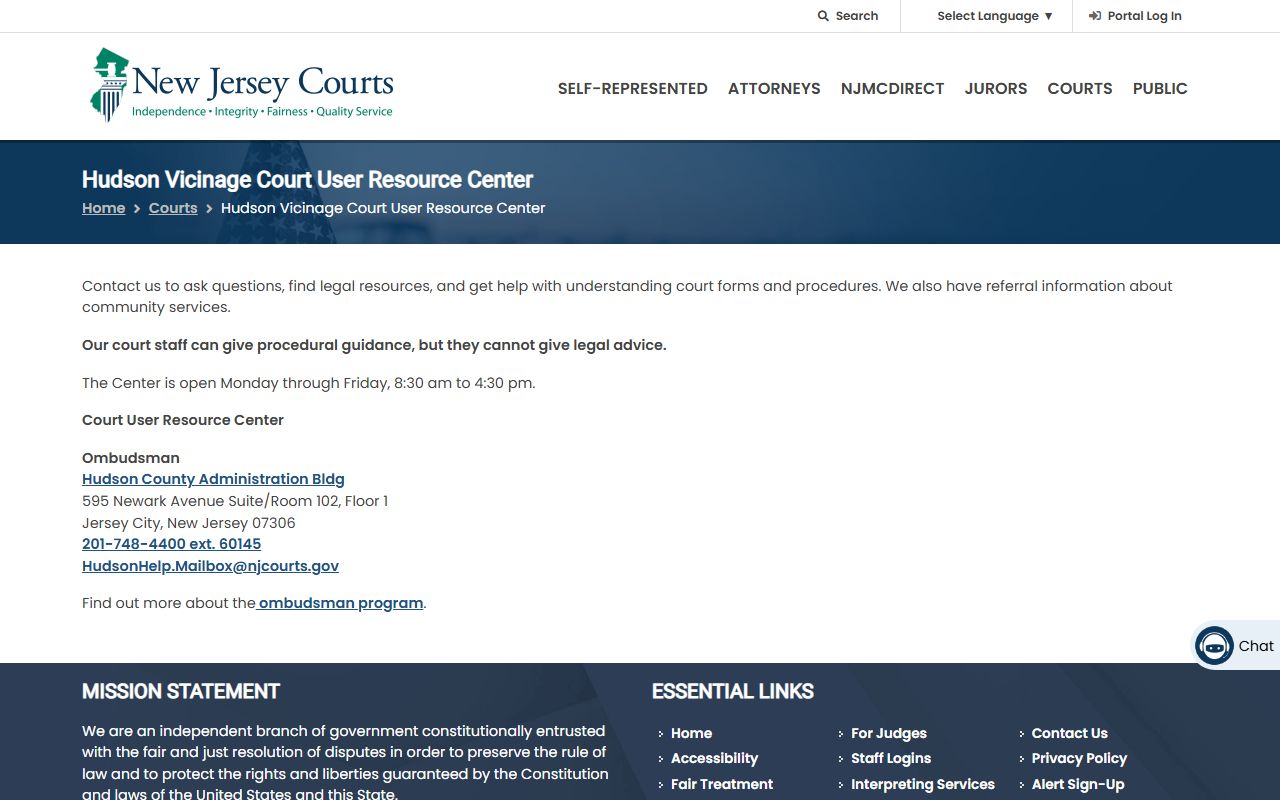
That page is the quickest way to confirm current Hudson County Clerk of Court contact details before you mail a request or visit in person. Hours and extensions can change, so check it first.
What the Clerk Does in Hudson County
The court-record clerk function in Hudson County covers the paperwork side of the trial court. Staff log new filings, assign docket numbers, keep the official case file, and produce copies on request. They also collect filing fees, issue some court process, and route requests that belong to other offices. They do not decide cases or give legal advice. Their job is to keep the record straight and accessible within the court rules.
- Accept and docket complaints, motions, and other filings
- Maintain official Superior Court case files for Hudson County
- Issue certified and plain copies of public court records
- Collect filing fees and process fee waiver paperwork
- Direct record seekers to the correct division or county office
Hudson County court files split by division. Civil and General Equity files are more open. Family Part and juvenile files carry heavy restrictions. The clerk staff applies Court Rule 1:38 when deciding what a member of the public can see.
Routing a Hudson County Records Request
Picking the right office is the hardest part of a Hudson County records request. Court case files are Judiciary records and go through the courts. County administrative records, deeds, and probate filings are held by separate constitutional offices. Send a request to the wrong place and it stalls. The split below is the key to getting records fast.
Court files, like a civil judgment, a criminal docket, or a divorce judgment, go through the New Jersey Judiciary and its records request process. Non-court county records go elsewhere. Deeds, mortgages, and liens sit with the County Register. Wills, estates, and guardianship intake sit with the Surrogate. Elections, trade names, passports, and county archives sit with the County Clerk. For those non-court offices, see the Hudson County Clerk page. For estate matters, see probate records.
Municipal matters add one more wrinkle. A traffic ticket or a disorderly persons complaint is held by the town's municipal court, not the Superior Court clerk. To get those records, you request them from the specific municipal court that heard the case. The vicinage clerk staff can point you, but they do not hold the municipal file.
Important: Open Public Records Act requests to county departments do not work for court case files; court records follow Judiciary rules, not county OPRA practice.
Online Tools for Hudson County Court Records
Before mailing a request, check whether the record is already online. Many Hudson County case details are searchable for free through the Judiciary. The state runs one hub that links the separate search systems by case type. Pulling a record online can save a trip to Jersey City and a copy fee.
Start at NJ Courts Find a Case, which routes you to civil, criminal, judgment lien, tax, and municipal searches. For civil and foreclosure matters, the civil case jacket portal shows docket numbers, parties, status, and event history. When a record is not available to download, the Judiciary's court records request page explains how to ask for a copy. Note: family and juvenile files are far more limited online than civil files, so many family records require a formal request.
The Find a Case hub is not one search box. It links separate tools by case type, and each clerk-held record category has its own path. Knowing the tool before you start cuts the work in half.
| Search Tool | What It Finds |
|---|---|
| Search Civil and Foreclosure Cases | Case jackets by party name or docket number. |
| Search Criminal Cases | Criminal cases by name or county. |
| Search Criminal Judgments | Defendant name, SBI, complaint, or indictment number. |
| Search Judgment Liens | Party name, judgment number, or docket number. |
| Find My Municipal Court Case | Ticket number or complaint number, usually required. |
| Request Court Records | Copy request process for records not available online. |
Reading a Hudson County Docket Number
A docket number is the clerk's index to a case. In New Jersey, the prefix tells you the division, which tells you which clerk file holds the record. Giving the full docket number to the clerk staff is the fastest way to pull a Hudson County court file. The common prefixes are worth knowing before you call or write.
- L
- Law Division civil lawsuit.
- DC
- Special Civil Part case, often a smaller money claim.
- LT
- Landlord-tenant matter.
- F
- Foreclosure case in General Equity.
- FM
- Family matrimonial, including divorce.
- FV
- Domestic violence matter.
When you only have names, the clerk staff or the public portal can still search, but exact and alternate spellings help. The same advice the County Register gives for property records applies to court searches: try every spelling variation before you give up.
How to Request a Certified Copy
A certified copy is a court copy stamped to show it is true and official. Courts, banks, and agencies often demand one. A plain copy is fine for reference, but it will not stand in a legal proceeding. The steps below outline how to get a certified Hudson County court record.
- Identify the case. Find the docket or case number, the division, and the party names so staff can pull the right file.
- Get the request form. Use the Judiciary's court records request process and the form linked from the NJ Courts self-help page.
- Submit the request with payment. Provide the case details, the document you need, and the number of copies, then pay the required fee.
- Receive the copy. Pick it up at the vicinage counter or wait for it by mail, depending on how you filed the request.
Restricted records, such as sealed, expunged, juvenile, or adoption files, are not released this way. Those follow separate court rules and may need a judge's order.
Records Request Form Fields
A clean request moves faster. The Judiciary's records request asks for specific case details so staff can find the file and confirm what is public. Give as much identifying data as you can. The table lists the common fields on a Hudson County court records request.
| Field | Required | Notes |
|---|---|---|
| Docket / Case Number | No | Strongly preferred; the fastest way to locate a file. |
| Party Names | Yes | Full legal names; add alternate spellings when known. |
| Division / Case Type | Yes | Civil, Criminal, Family, General Equity, or Special Civil. |
| Document Type | Yes | Judgment, order, complaint, or other named filing. |
| Number of Copies | Yes | State plain or certified for each copy. |
| Requester Contact | Yes | Name, mailing address, phone, and email for response. |
Hudson County Court Record Fees
Copy and certification fees for court records are set by the Judiciary, not posted as a fixed county clerk price list on this page. Amounts depend on the document, the number of pages, and the type of copy. Because no Hudson-specific clerk fee chart was confirmed in the official sources, the safest move is to confirm the current charge before you submit. Two official pages cover the cost and waiver questions.
- NJ Courts court records request explains how copies are ordered and what they cost.
- NJ Courts fee waiver covers relief from fees for those who qualify by income.
People with low income can ask the court to waive certain fees. The fee waiver page lists who qualifies and how to file the request. Note: confirm the exact copy and certification charge with the court before mailing payment, since rates are set by the Judiciary and can change.